
Introduction
In Part 1, I walked through the case for domain-specific LLMs: why general-purpose models fall short in enterprise settings, how a focused 7B parameter model achieved 95% accuracy on domain tasks for just $15 per training run, and why data quality matters more than data quantity. The core argument was simple. Specialists outperform generalists in their domain, and the economics of building one are already within reach.
But the natural follow-up question is: which industries should actually build one?
The honest answer is that many are strong candidates. Finance, healthcare, legal, insurance, manufacturing: any vertical with deep proprietary knowledge, specialized terminology, and high-stakes decisions has a legitimate case for a custom model. Not every industry needs one, and not every use case justifies the investment. The key is knowing how to evaluate whether your domain is the right fit.
I have spent the last several years working closely with one industry in particular. I have seen its operational complexity from the inside, studied how its professionals make decisions, and observed where general-purpose AI consistently falls short. The more I looked, the more convinced I became that this industry is not just a good candidate for domain-specific AI. It is one of the best.
The industry is Travel and Tourism.
In this article, I will share the framework I use to evaluate whether an industry is the right candidate for an enterprise LLM, and I will apply it in detail to Travel and Tourism. By the end, you should be able to apply the same framework to your own vertical and make an informed decision about whether building a custom model is worth the investment.
A $10.9 Trillion Industry with a Knowledge Problem
The scale of this industry is staggering.
Travel and Tourism contributes $10.9 trillion to global GDP, representing roughly 10% of the world economy, and supports 357 million jobs worldwide, approximately one in every ten jobs on the planet.2 This is not a niche vertical. This is one of the largest industries on Earth, touching airlines, hotels, cruise lines, tour operators, online travel agencies, ground transportation, food and beverage, and a vast ecosystem of supporting services.
Within this ecosystem, the hotel sector alone generates approximately $492 billion in revenue annually, encompassing roughly 187,000 hotels with 17.5 million rooms worldwide.111 Airlines, cruise, and other sub-verticals add hundreds of billions more.
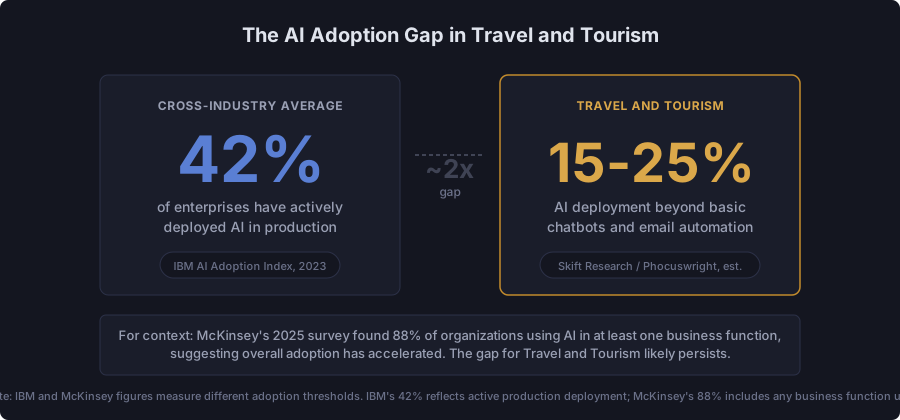
And yet, when it comes to AI adoption, Travel and Tourism lags behind. While 88% of organizations across industries are using AI in at least one business function,3 the sector's AI deployment beyond basic chatbots and email automation remains in the range of 15–25%, according to multiple industry surveys by Skift Research and Phocuswright. The gap between aspiration and execution is enormous.
Why?
Because Travel and Tourism is not a simple domain. It is one of the most complex operational environments in any service industry. Airlines manage thousands of fare classes across hundreds of routes. Hotels juggle rate codes, room types, and channel distribution across dozens of systems. Cruise lines coordinate itineraries, cabin inventory, and onboard revenue across multi-week voyages. Every sub-vertical has its own deep operational language, and general-purpose AI models, no matter how powerful, are not built to handle that complexity.
The Parable of the Grand Hotel
Before the technical domain analysis, a story that captures why this industry is different.
Imagine two hotels, side by side on the same beach. Same view. Same number of rooms. Same star rating. One is a luxury boutique brand. The other is a well-known global chain. A guest walks into the boutique hotel and is greeted by name, offered their preferred room type without asking, and receives a handwritten note from the general manager. They walk into the chain hotel next door and get a perfectly efficient check-in, a clean room, and a generic welcome email.
Both delivered a good experience. But only one delivered their experience. The boutique hotel's service felt personal, intentional, and distinctly theirs. The chain hotel's service felt interchangeable.
Now imagine both hotels deploy AI assistants. If both use the same general-purpose model, both AI assistants will sound the same. The same tone, the same phrasing, the same personality. The boutique hotel's carefully cultivated brand voice, the thing that makes guests pay a premium and come back year after year, gets flattened into a generic AI response indistinguishable from every other hotel's AI.
Research from Lucidpress (now Marq) found that consistent brand presentation across all platforms increases revenue by up to 23%.4 In hospitality, where brand differentiation is the product itself, a generic AI voice is not just a missed opportunity. It is brand erosion.
A Framework for Domain Fitness
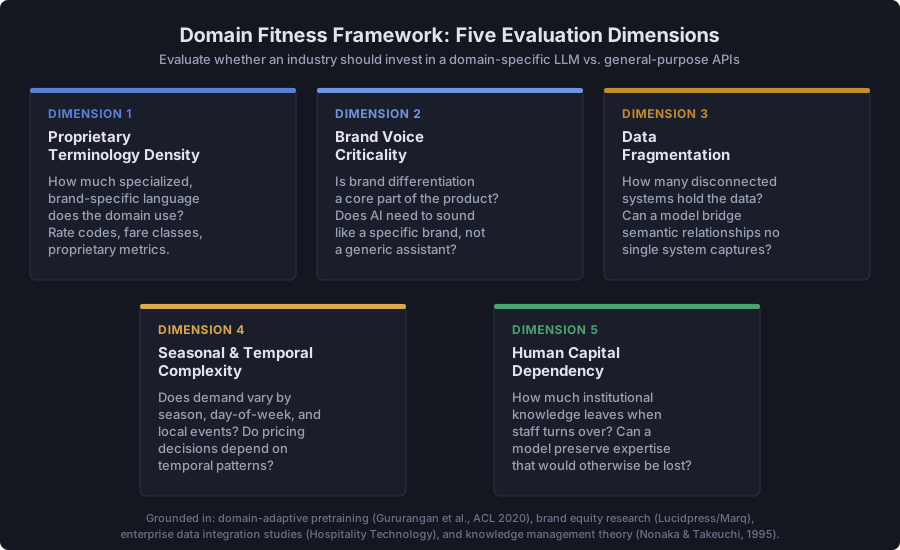
Not every industry is equally suited for domain-specific AI. Some verticals can get by with general-purpose models plus a good prompt. Others have characteristics that make them ideal candidates for fine-tuning. The question is how to tell the difference.
During my experiments, I developed a framework for evaluating domain fitness across five dimensions. These dimensions are grounded in established research: research on domain-adaptive pretraining in NLP,14 brand equity and consistency research,4 enterprise data integration studies,10 time-series forecasting literature from hospitality operations research,12 and knowledge management theory on tacit knowledge transfer.15 Together, they provide a structured way to evaluate whether an industry should invest in building its own model versus relying on general-purpose APIs.
I will apply this framework to Travel and Tourism as a whole, with specific examples from across its sub-verticals.
Dimension 1: Proprietary Terminology Density
Every sub-vertical in Travel and Tourism operates with a language of its own. Airlines have fare classes (Y, B, M, Q), cabin designators, PNR structures, and yield management terminology. Cruise lines have cabin categories, itinerary codes, and onboard revenue classifications. Hotels have rate codes, room type designations, loyalty tier structures, and revenue metrics. These are not generic terms. They are proprietary, brand-specific, and often conflicting across companies within the same sub-vertical.
In hotels alone, a major brand can operate with hundreds or even thousands of unique rate codes. A "BAR" rate at one chain means something subtly different from a "BAR" at another. A "Deluxe Room" at a Four Seasons is a fundamentally different product from a "Deluxe Room" at a Hampton Inn, even though they share the same label.
The standard hotel metrics alone form a specialized vocabulary that general-purpose models consistently misapply:
- RevPAR (Revenue Per Available Room) = ADR × Occupancy Rate
- ADR (Average Daily Rate)
- GOPPAR (Gross Operating Profit Per Available Room)
- TRevPAR (Total Revenue Per Available Room)
- ARI (Average Rate Index), your ADR versus the competitive set
- RGI (Revenue Generation Index), your RevPAR versus the competitive set
- Net RevPAR, RevPAR minus distribution costs
Ask a general-purpose LLM to calculate displacement analysis for a group booking versus transient demand on a compression night, and watch it struggle. Not because it is not intelligent, but because it has never been trained to think the way a revenue manager thinks. It does not know that a compression night means demand exceeds supply, that displacement analysis weighs group revenue against the transient revenue it displaces, or that ancillary revenue from groups (food and beverage, meeting space, AV equipment) can significantly exceed the room revenue alone.
A fine-tuned model knows all of this. Not because it looked it up. Because it was trained on it.
Dimension 2: Brand Voice Criticality
The Grand Hotel parable illustrated this qualitatively. The numbers reinforce it.
A Salesforce survey of 16,000+ consumers found that 73% of customers now feel companies treat them as individuals rather than numbers, up dramatically from 39% in 2023.5 At the same time, 61% of customers say AI advancements make corporate trustworthiness more critical, and 86% of consumers say authenticity is a key factor when deciding what brands they support.6
In hospitality, brand voice is not marketing. It is the product. The way a Ritz-Carlton communicates should feel fundamentally different from a citizenM. The warmth, the formality, the level of detail, the personality: all of it should be as distinctive as the physical property itself.
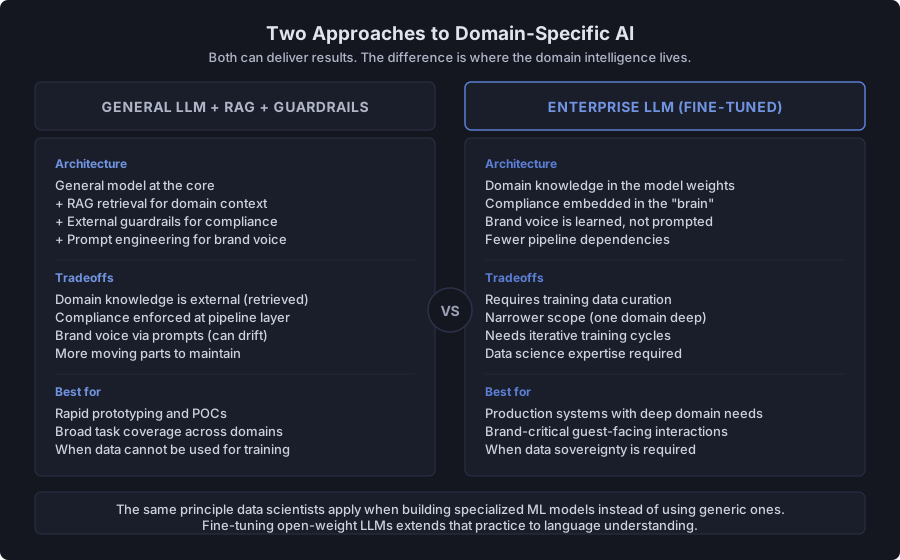
General-purpose models produce general-purpose responses. They can be prompted to adopt a tone, but prompting is fragile. It drifts across conversations, it fails under edge cases, and it cannot internalize the deep brand DNA that comes from being trained on thousands of brand-specific interactions. Fine-tuning makes brand voice a permanent part of the model's personality, not a temporary instruction that can be overridden.
Dimension 3: Data Fragmentation
Travel and Tourism runs on a patchwork of specialized systems that rarely talk to each other. Airlines operate on Global Distribution Systems (GDS), departure control, loyalty platforms, and crew management. Cruise lines coordinate reservation systems, shore excursion platforms, and onboard POS. And in hotels, the average full-service property runs on 20 to 30 different technology systems.10 Property Management System (PMS), Central Reservation System (CRS), Customer Relationship Management (CRM), Revenue Management System (RMS), Point of Sale, spa management, loyalty platforms, OTA channel managers, guest messaging systems, housekeeping management, engineering work orders, and more.
Guest data is scattered across all of them. Industry surveys suggest that only about a third of hotels have achieved a unified view of their guest data across these systems.10
This is not a technology failure. It is the natural consequence of an industry that evolved by bolting on specialized systems over decades. But it creates a fundamental challenge for AI: if the model does not understand how these systems relate to each other, it cannot reason about the complete guest journey.
A general-purpose model has no concept of how a PMS reservation links to a CRM loyalty profile, connects to a RMS rate recommendation, and flows into a guest messaging interaction. A domain-specific model can be trained to understand these relationships, bridging data silos not by integrating the systems (that is an infrastructure problem), but by understanding the semantic relationships between the data they hold.
Dimension 4: Seasonal and Temporal Complexity
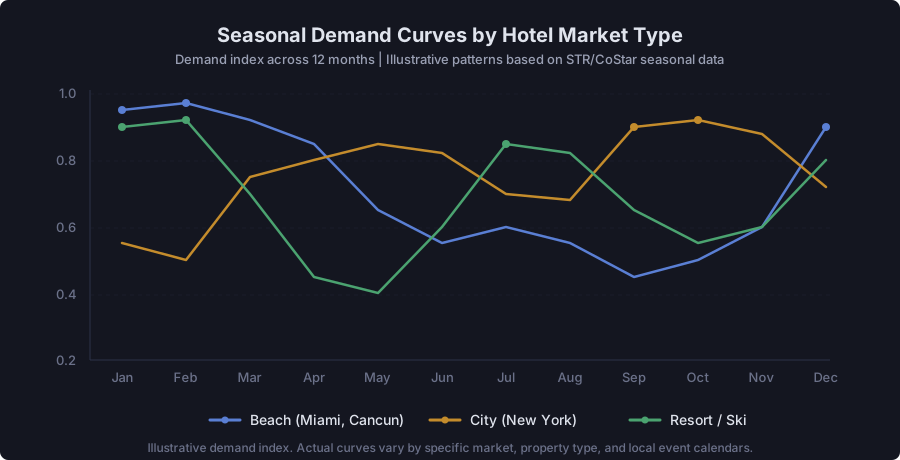
Demand in Travel and Tourism is anything but steady. Airlines see dramatic swings around holidays and school breaks. Cruise lines plan itineraries years in advance around seasonal weather patterns. And in hotels, the variability is especially pronounced: demand variability of 40–60% between peak and off-peak seasons,11 with some resort markets seeing occupancy swing from 95% to below 30%. A beach resort in Miami peaks from December through April and dips during hurricane season. A city hotel in New York peaks in fall and spring but softens in January. A ski resort inverts the pattern entirely.
Layered on top of seasonal patterns are:
- Day-of-week patterns: business hotels strong Monday through Thursday, leisure strong Friday through Sunday
- Local event calendars: conventions, festivals, sports events that create compression
- Booking windows: business travelers tend to book days or weeks out, leisure travelers weeks to months in advance, and groups often book quarters ahead. Each pattern requires different pricing strategies.
- Cancellation patterns: the "wash factor" of expected cancellations and no-shows, which varies by segment and season
- Competitive dynamics: a new hotel opening nearby, a competitor's renovation, OTA promotional activity
A general-purpose model with the right retrieval pipeline can be given this information, but it has to look it up every time. It does not intuitively know that a "compression night" in Miami in February means every hotel is full and rates should be at maximum, or that a shoulder season in September calls for targeted promotions with length-of-stay incentives. A fine-tuned model internalizes these patterns the way an experienced revenue manager does.
Revenue managers internalize these patterns over years of experience. A fine-tuned model can internalize them in a training run.
Dimension 5: The Labor Crisis
The hospitality industry has a structural workforce problem that is not going away.
The accommodation and food services sector in the United States has the highest turnover rate of any industry, averaging 70–80% annually.8 The quit rate runs roughly double the national average.8 Hotels remain approximately 10–15% below pre-pandemic staffing levels.9
Every time an experienced revenue manager, front desk agent, or guest services director leaves, they take institutional knowledge with them.15 The new hire needs weeks or months to learn the property's systems, rate structures, guest preferences, and operational nuances. The training investment is significant, and much of it walks out the door within a year.
A domain-specific AI model does not quit. It does not forget. It does not need to be retrained from scratch when a team member leaves. It retains the institutional knowledge permanently, serving as a knowledge backbone that supplements and supports human staff rather than replacing them.
The Revenue Management Deep Dive
One area where domain-specific AI delivers immediate, measurable value is revenue management.
McKinsey has estimated that hotels without sophisticated revenue management systems leave approximately 2–5% of potential revenue on the table.13 Applied to the hotel sector's $492 billion in annual revenue,1 that implies roughly $10–25 billion in unrealized revenue worldwide. Research from Cornell's School of Hotel Administration has found that AI-powered revenue management systems can improve RevPAR by 5–20% depending on starting maturity.12
Revenue management is a decision-intensive discipline. Every day, a revenue manager at a full-service hotel makes dozens of pricing decisions across room types, rate codes, channels, and booking windows. They are weighing:
- Market position: How are we priced relative to our competitive set? Are we gaining or losing market share?
- Demand forecast: What does the pickup look like for the next 90 days? Are we pacing ahead or behind?
- Channel mix: What percentage of bookings are coming through OTAs (at 15–20% commission) versus direct (at near-zero distribution cost)?
- Group displacement: Should we accept a group booking of 80 rooms at $180/night when our transient ADR is $250? What revenue will we displace?
- Rate fencing: How do we offer lower rates to price-sensitive segments without cannibalizing full-rate business?
A general-purpose LLM can discuss these concepts at a surface level. A fine-tuned model can do the analysis. It knows that when occupancy forecast exceeds 85% and a group rate is more than 15% below ADR, the displacement math usually argues against acceptance. It knows that shifting just 1% of bookings from OTA to direct channels saves approximately rooms × ADR × 365 × 0.01 × 0.175 in commission costs annually. It knows that an advance purchase rate with a 21-day booking window and non-refundable terms is a legitimate rate fence, not a discount.
This is the difference between a model that has read about revenue management and a model that has been trained to practice it.
The Guest Experience Equation
Revenue management is only half the story. The other half is guest experience, and the two are deeply interconnected.
Research from Cornell's School of Hotel Administration found that a one-point increase in guest satisfaction scores (on a 5-point scale) correlates with a $1.42 increase in RevPAR and a 0.5% increase in occupancy.12 Guest satisfaction is not a soft metric. It is a leading indicator of revenue.
In the showcase demo I am building, the Guest Experience agent tracks:
- NPS (Net Promoter Score) across segments: business travelers, leisure couples, families, luxury seekers, group events. Each segment has different expectations, different pain points, and different Customer Lifetime Value. The model needs to understand that a high-value repeat guest demands a fundamentally different response than a price-sensitive one-time visitor.
- Review sentiment analysis across platforms: TripAdvisor, Google, Booking.com, Expedia. Not just aggregate scores, but theme-level sentiment covering cleanliness, staff friendliness, location, amenities, value for money, food quality, room comfort, and WiFi.
- Complaint pattern analysis: not just what guests complain about, but when complaints peak seasonally, how severe each category's impact is on overall ratings, and what the resolution path looks like. A domain-specific model can learn that check-in delays have a disproportionately high impact on satisfaction compared to, say, parking availability.
A general-purpose model can do basic sentiment analysis. A hospitality-specific model understands that a WiFi complaint at a business hotel is a higher-severity issue than the same complaint at a beachfront resort, because the guest segments and their expectations differ.
The insight that makes this powerful is the connection between the two domains. Neither revenue management nor guest experience operates in isolation. When your NPS drops among business travelers, it is a leading signal that corporate bookings will decline next quarter. When your competitive set's reputation scores improve while yours stagnate, you are about to lose market share, and no amount of rate cutting will fix it.
The Data Privacy Imperative
There is one more dimension that makes Travel and Tourism uniquely suited for self-hosted, domain-specific AI: the sensitivity of the data.
This industry collects some of the most personal data of any sector. Airlines hold passport numbers, frequent flyer histories, and travel itineraries. Cruise lines track dietary needs, medical conditions, and shore excursion preferences. Hotels collect credit card numbers, room preferences, anniversary dates, companion information, and disability accommodations. This is not abstract "user data." This is deeply personal information about where people sleep, what they eat, who they travel with, and how they spend their money.
The IBM Global AI Adoption Index found that data privacy (57%) is the single biggest barrier preventing organizations from adopting generative AI.7 And Salesforce found that 64% of customers perceive companies as careless with personal data, while 71% feel increasingly protective of their information.5
A self-hosted, domain-specific model addresses this directly. Guest data never leaves the hotel's infrastructure. There is no third-party API processing personal information. There is no question about where the data goes or who has access. The model lives inside your walls, trained on your data, serving your guests.
For regulated markets like the European Union with GDPR, California with CCPA, and the growing patchwork of global privacy laws, this is not just a preference. It is increasingly a compliance requirement.
From Industry to Case Study: Why Hospitality
Travel and Tourism is a vast industry. Airlines, cruise lines, tour operators, online travel agencies, ground transportation, food and beverage: each sub-vertical could justify its own domain-specific model. But to walk through the end-to-end process of building an enterprise LLM, from domain analysis to training data to deployment, we need to focus.
The sub-vertical I know best is hospitality. Hotels. Resorts. The places where a stranger walks through the door and expects to feel like they belong. Where a brand promise is not a tagline on a website but a lived experience delivered by real people, hundreds of times a day, across thousands of properties, in dozens of countries.
Hospitality scores exceptionally high across all five dimensions of the fitness framework, as we have seen throughout this analysis. It is where I have spent the most time, where I have the deepest understanding of the operational decisions, and where I have already built and tested a working system. For the remainder of this series, hospitality will be our case study for building an enterprise LLM from the ground up.
Here is what that system looks like.
What I Am Building
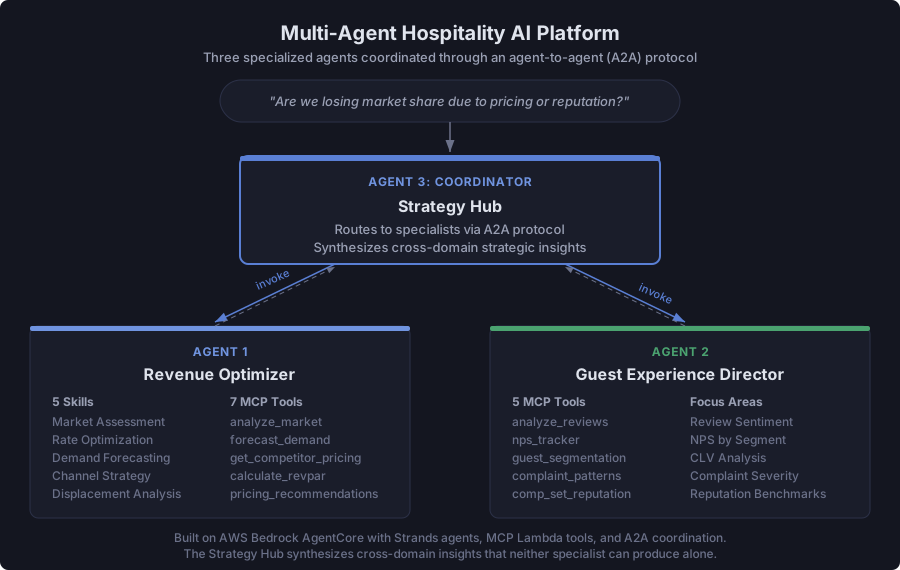
What I am building is a multi-agent hospitality AI platform. Not a single model, but a system of specialized agents, each expert in its domain, coordinated by an orchestrator that synthesizes their insights.
Three agents. Three domains. One strategy.
Revenue Optimizer
Market analysis, demand forecasting, competitive pricing, rate optimization, channel strategy, and displacement analysis. Speaks the language of RevPAR, ADR, compression nights, and rate fences. Five specialized skills. Seven integrated tools.
Guest Experience Director
Review sentiment analysis, NPS tracking across guest segments, competitive reputation benchmarking, guest segmentation with CLV analysis, and complaint pattern analysis. Understands that a billing error at −0.5 rating impact requires different handling than a parking complaint at −0.1.
Strategy Hub
A coordinator agent that connects both specialists through an agent-to-agent protocol. When a hotel leader asks a cross-domain question, the Hub routes to the right specialists and synthesizes a unified strategic recommendation.
This architecture mirrors how the best hotels actually operate. Revenue management and guest experience are separate disciplines with separate expertise, but the best strategic decisions happen when both perspectives are in the room. The Strategy Hub is the AI equivalent of that meeting.
Hospitality is not the only sub-vertical within Travel and Tourism where this framework applies. Airlines, with their thousands of fare classes and deeply specialized yield management, face similar challenges. Cruise lines, coordinating multi-week voyages across cabin inventory, onboard revenue, and itinerary planning, are at least as complex. The broader industry is rich with candidates for domain-specific AI. But hospitality is the sub-vertical where I have the deepest experience, and it is where this series will go next.
What Comes Next
Now that we have established the framework and chosen our case study, the real work begins. In Part 3, I will dive into the hardest part of building a domain-specific model: training data curation. How do you build a dataset that teaches a model to think like a hotel revenue manager? What does a good training example look like versus a bad one? How do you handle the synthetic data challenge when proprietary hotel data cannot be shared? And what did the 77% duplication discovery from Part 1 teach me about the art of building datasets that actually work?
If Part 1 was the "why" and Part 2 is the "where," Part 3 is the "how." From here on, every article in the series will use hospitality as the lens through which we build, test, and deploy an enterprise LLM end to end.
Further Reading and References
- Statista. (2025). Hotels: Worldwide Market Forecast. statista.com. Global hotel market revenue of $492 billion (2026), projected to reach $638 billion by 2030. ↑
- WTTC. (2024). Economic Impact Research 2024. In partnership with Oxford Economics. wttc.org. Travel and tourism contributed $10.9 trillion to global GDP, supporting 357 million jobs. ↑
- McKinsey & Company. (2025). The State of AI in 2025: Agents, Innovation, and Transformation. McKinsey Global Survey. mckinsey.com. 88% of organizations using AI in at least one business function; nearly two-thirds have not begun scaling. ↑
- Lucidpress/Marq. (2023). The Impact of Brand Consistency. marq.com. Consistent brand presentation increases revenue by up to 23%. ↑
- Salesforce. (2025). State of the AI Connected Customer. Survey of 16,000+ consumers. salesforce.com. 73% of customers feel treated as individuals; 61% say AI makes trustworthiness more critical; 64% perceive companies as careless with data; 71% feel increasingly protective of personal information. ↑
- Stackla (now Nosto). (2021). Bridging the Gap: Consumer & Marketing Perspectives on Content in the Digital Age. web.archive.org (stackla.com). 86% of consumers cite authenticity as a key factor in brand preference. Stackla was acquired by Nosto in 2022; original report archived. ↑
- IBM & Morning Consult. (2023). IBM Global AI Adoption Index 2023. newsroom.ibm.com. Data privacy (57%) is the top barrier to generative AI adoption. ↑
- U.S. Bureau of Labor Statistics. (2023–2024). Job Openings and Labor Turnover Survey (JOLTS). bls.gov. Accommodation and food services: 70–80% annual turnover, highest of any U.S. sector. ↑
- AHLA. (2023–2024). State of the Hotel Industry Reports. ahla.com. Hotels remain 10–15% below pre-pandemic staffing levels. ↑
- Hospitality Technology / h2c. (2023–2024). Lodging Technology Studies. hospitalitytech.com. Average full-service hotel uses 20–30 technology systems; 70% of hoteliers plan to increase IT spending with AI as top priority. ↑
- STR/CoStar Group. (2024). Global Hotel Census and Seasonal Data. str.com. Approximately 187,000 hotels with 17.5 million rooms worldwide; seasonal demand variability of 40–60%. ↑
- Anderson, C. K. (2012). The Impact of Social Media on Lodging Performance. Cornell Hospitality Report, Vol. 12, No. 15. sha.cornell.edu. Established the relationship between guest satisfaction scores and RevPAR; subsequent Cornell research by Enz, Canina, and others confirmed RevPAR improvements of 5–20% from AI-powered revenue management systems. ↑
- McKinsey & Company. (2023). Cashing in on the US Hotel Industry's Moment. McKinsey Travel, Logistics & Infrastructure Practice. mckinsey.com. McKinsey's hospitality practice research indicates hotels without sophisticated revenue management leave 2–5% of potential revenue unrealized. ↑
- Gururangan, S., Marasovic, A., Swayamdipta, S., et al. (2020). Don't Stop Pretraining: Adapt Language Models to Domains and Tasks. ACL 2020. arxiv.org/abs/2004.10964. Showed that a second phase of in-domain pretraining (domain-adaptive pretraining) leads to significant performance gains, and that task-adaptive pretraining improves results further. ↑
- Nonaka, I. & Takeuchi, H. (1995). The Knowledge-Creating Company. Oxford University Press. Foundational work on tacit knowledge transfer in organizations, directly relevant to how institutional expertise is lost when experienced staff leave. ↑

Up Next in the Series
Part 3 will dive into training data curation, the art and science of building a dataset that teaches a model to think like a hospitality expert.